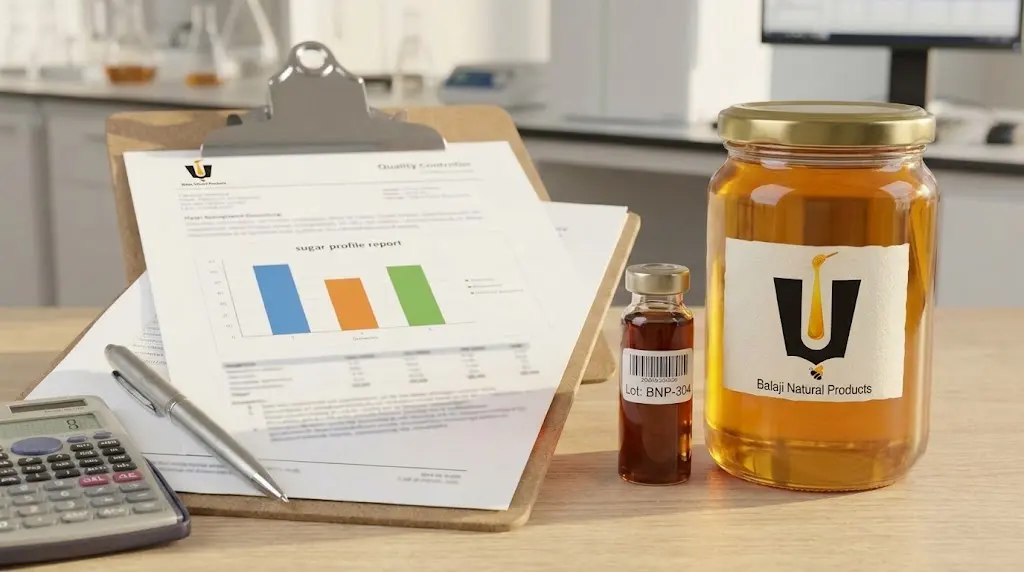
Honey is mostly sugar, but not just any sugar. The balance of fructose, glucose and sucrose shapes how honey tastes, how fast it crystallises, how it behaves in your recipe and whether it is genuine.
That makes the sugar profile one of the most useful lines on a certificate of analysis. Whether you buy for a factory in India or import through a Honey Exporter India, understanding these numbers helps you choose the right honey and spot problems early.
This guide explains what a honey sugar profile is, what the main sugar levels mean, which limits apply under Indian and international standards, and what buyers should check before approving a lot.
What Is a Honey Sugar Profile?
A sugar profile is a laboratory breakdown of the individual sugars in a honey sample. It usually reports:
Fructose, the main sugar in most honeys
Glucose, the second main sugar
Sucrose, ordinary table sugar, present only in small amounts in genuine honey
Fructose plus glucose, or total reducing sugars
The fructose-to-glucose (F/G) ratio
Sometimes maltose and other minor sugars
The Codex Standard for Honey describes honey as consisting essentially of different sugars, predominantly fructose and glucose. India's FSSAI standard uses the same description.
The Three Key Sugars in Honey
Fructose
Fructose is usually the largest single sugar in honey. It tastes sweeter than table sugar and stays dissolved more easily, so honeys rich in fructose tend to remain liquid for longer.
Glucose
Glucose is the second main sugar. It is less soluble than fructose, and it is the sugar that forms crystals when honey sets. Honeys with relatively high glucose crystallise faster. Mustard honey, for example, is known for crystallising quickly.
Sucrose
Bees convert most of the sucrose in nectar into fructose and glucose using natural enzymes. Ripe, genuine honey therefore contains only a small amount of sucrose.
A high sucrose result can point to immature honey, bees fed with sugar syrup, or direct addition of cane or beet sugar. That is why both Indian and international standards set a maximum.
Fructose Glucose Ratio in Honey
The F/G ratio compares the amount of fructose with the amount of glucose. It is one of the most practical numbers for buyers because it predicts crystallisation.
A higher F/G ratio usually means the honey stays liquid for longer.
A lower F/G ratio usually means faster, firmer crystallisation.
India's FSSAI standard requires an F/G ratio between 0.95 and 1.50. A result outside this range is a warning sign that the honey may be mislabelled, blended with syrup or otherwise not compliant.
The ratio also varies naturally with floral source and season. That is why a sample approved in one season may behave differently from a lot harvested in another.
Indian and International Sugar Limits
Buyers often need to meet both Indian rules and the standards of an importing country. Here is how the two main benchmarks compare.
FSSAI Standard (India)
Under the FSSAI standard for honey, key sugar limits include:
Total reducing sugars: minimum 65% by mass for most honeys; minimum 60% for honeydew honey and Carvia callosa honey; minimum 45% for blends of honeydew and blossom honey
Sucrose: maximum 5% by mass for most honeys; maximum 10% for honeydew honey and Carvia callosa honey
F/G ratio: 0.95 to 1.50
C4 sugar: maximum 7% by mass, to detect corn or cane syrup
Codex Standard (International)
The Codex Standard for Honey, used as a reference by many countries, sets:
Fructose plus glucose: minimum 60 g per 100 g for blossom honey; minimum 45 g per 100 g for honeydew honey and its blends with blossom honey
Sucrose: maximum 5 g per 100 g for most honeys, with higher limits of 10 g for a short list of floral sources such as citrus and alfalfa, and 15 g for lavender and borage honey
Sucrose Limit in Honey: Why the Exceptions Exist
A few floral sources naturally contain more sucrose, so both standards allow a higher limit for them. If your supplier claims an exception, ask for pollen analysis that confirms the floral source.
Honey Sugar Analysis: How Sugars Are Tested
Sugar profiles are measured in a laboratory, not by sight or taste.
The most common method is high-performance liquid chromatography (HPLC), which separates and measures each sugar individually. The Codex standard references harmonised HPLC methods from the European Honey Commission for fructose, glucose and sucrose.
Sugar profiling works best alongside other tests:
Moisture, since a high water content can affect results and fermentation risk
C4 sugar and carbon isotope tests, for added corn or cane syrup
Rice syrup markers and foreign oligosaccharides, for starch-based syrups
NMR profiling, for advanced adulteration screening
A normal sugar profile alone does not prove purity. Some modern syrups are designed to mimic honey's sugar balance, which is why layered testing matters.
Why Sugar Profiles Matter for Business Buyers
Product Performance
Sugar balance affects how honey behaves in production. It influences:
Sweetness, which can change how much honey a recipe needs
Browning, since reducing sugars brown faster when heated
Moisture retention in baked goods
Viscosity and flow through pumps and pipes
Crystallisation and Shelf Appearance
For retail and private-label jars, crystallisation affects how the product looks on the shelf. A honey with a lower F/G ratio may set in the jar within weeks. That is fine if you sell creamed honey, but a problem if customers expect a clear liquid.
Authenticity and Compliance
Sugar results outside normal ranges can be an early warning of adulteration or immature honey. They also decide whether a lot meets FSSAI or importing-country rules.
What to Check on a Certificate of Analysis
When a Honey Supplier India sends a certificate of analysis, check the sugar section carefully:
1.Individual values are reported for fructose, glucose and sucrose, not just "complies".
2.The F/G ratio is shown or can be calculated, and falls within 0.95 to 1.50 for FSSAI.
3.Sucrose is within the limit for the stated floral source.
4.Reducing sugars or F+G meet the relevant minimum.
5.The test method is named, ideally HPLC.
6.The lot number matches the honey being offered.
7.The laboratory is accredited for honey testing.
Specifying Sugar Profiles in Your Contract
If sugar balance matters for your product, put it in writing. A Bulk Honey Supplier India can match a profile more reliably when the target is clear.
Consider specifying:
The honey variety and acceptable F/G ratio range for your application
Maximum sucrose
The test method and laboratory
Whether you need liquid honey or accept crystallisation
A retained reference sample from the approved lot
A Honey Manufacturer India controls much of this at the plant by keeping floral lots separate and blending only when the order calls for it. Ask how your supplier manages consistency across seasons.
Conclusion
Fructose, glucose and sucrose levels tell you a great deal about a honey. They affect taste, crystallisation and performance in production, and they help you judge authenticity and compliance.
Check the full sugar profile on every certificate, compare it with FSSAI and Codex limits, and set clear targets in your contract. Working with a Honey Exporter India that reports individual sugar values for each lot makes those checks faster and more reliable.
Balaji Natural Products keeps floral lots distinct at its Sonipat plant, and the tests that travel with each lot are named in the contract. Share your honey variety, specification and destination to request a quotation.
[Contact Us: Balaji Natural Honey]