Honey is one of the most commonly faked foods in the world. Sugar syrups cost far less than real honey, and some are now engineered to pass routine purity tests.
For food manufacturers, private-label brands and importers, this is a serious business risk. Adulterated honey can damage product quality, trigger recalls and harm a brand's reputation.
This guide explains the common types of honey adulteration in India, how laboratories detect them, what Indian and international standards require, and what to ask your Honey Supplier India before you buy.
What Is Honey Adulteration?
Honey adulteration means adding anything to honey, or changing it, so that it is no longer the pure natural product it claims to be.
The international Codex Standard for Honey is clear on this point. Honey sold as such must not have any food ingredient or additive added to it. India's food regulator, FSSAI, follows the same principle in its own standard.
Adulteration is usually economic. A seller earns more by stretching real honey with cheaper sweeteners or by passing off low-cost honey as a premium variety.
Common Types of Honey Adulteration in India
Honey fraud takes several forms. Some are easy to detect; others need advanced laboratory testing.
1. Direct Addition of Sugar Syrups
This is the most common form. Cheap syrups are mixed into honey to increase volume.
Syrups fall into two broad groups based on the plant they come from:
C4 plant syrups, made from corn (maize) or sugarcane
C3 plant syrups, made from rice, beet or wheat
The difference matters because C4 syrups are easier to detect with standard isotope tests. C3 syrups, especially rice syrup, are much harder to catch.
2. Modified and "All-Pass" Syrups
Some syrup makers now market products designed to pass specific purity tests. In its 2020 investigation, the Centre for Science and Environment (CSE) reported finding syrups advertised as able to beat standard honey tests.
These modified syrups are the main reason buyers can no longer rely on basic testing alone.
3. Feeding Bees Sugar During Nectar Flow
Some producers feed sugar syrup to bees while they are producing honey. The resulting honey contains sugars that did not come from flowers, even though bees processed them.
4. Immature Honey Dried Artificially
Honey harvested before bees have ripened it has high moisture. Some processors remove the extra water by machine. This can change the honey's natural character and enzyme activity.
5. Mislabelling Floral or Geographic Origin
A cheaper honey may be sold as a premium variety, such as litchi or sidr, or as coming from a region it does not come from. This is fraud even if the product is real honey.
6. Excessive Heating or Filtering
Heavy heating and ultra-filtration can hide a honey's origin by removing pollen, and they can lower quality. Codex requires that honey with significant pollen removed be labelled "filtered honey".
How to Detect Adulterated Honey: Laboratory Methods
No single test catches every type of fraud. Reliable buyers use a combination of tests, matched to the risk.
Basic Physicochemical Tests
These check whether honey falls within normal ranges:
Moisture content, which indicates ripeness and fermentation risk
Sugar profile, including fructose, glucose and sucrose levels
HMF (hydroxymethylfurfural), which rises with heat and age
Diastase activity, an enzyme that falls with heating
Proline, an amino acid that comes mainly from bees
Electrical conductivity, which helps separate blossom and honeydew honey
These tests catch crude adulteration and quality problems. However, many modern syrups are designed to pass them.
C4 Sugar (Carbon Isotope) Test
This test compares carbon isotope ratios in the honey and in its protein. Sugars from corn and sugarcane have a different isotope signature from typical honey, so added C4 syrup shows up as a mismatch.
It is effective against C4 syrups but cannot reliably detect rice or beet syrup.
Rice Syrup Markers and Oligosaccharides
Rice syrup can leave chemical traces. India's standard requires that a specific marker for rice syrup, 2-AFGP, be absent. It also limits foreign oligosaccharides, which can indicate added starch-based syrups.
Pollen Analysis
Pollen counts and pollen identification help confirm that honey is genuine and that its floral or geographic label is accurate.
NMR Test for Honey
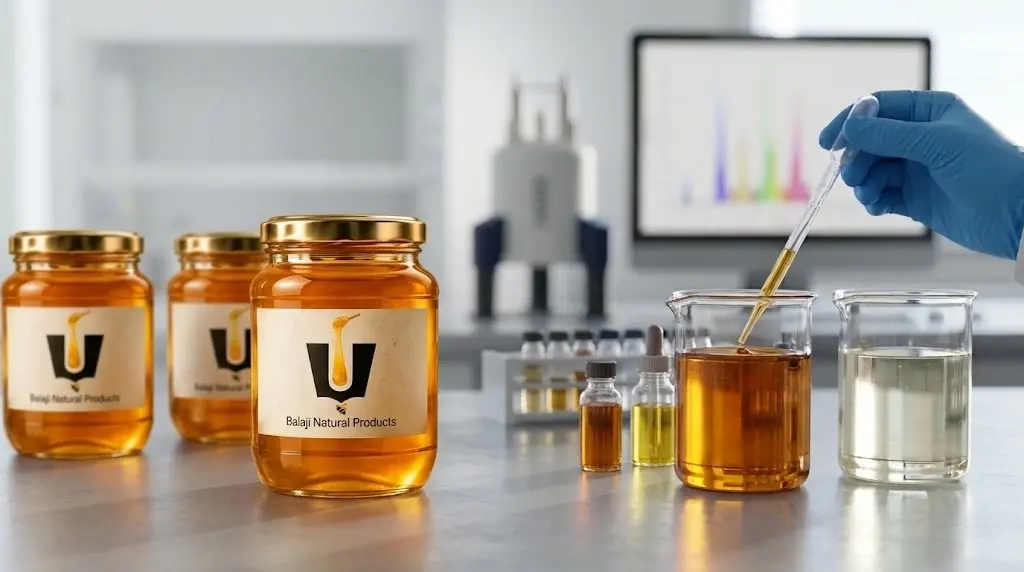
Nuclear Magnetic Resonance (NMR) profiling reads the overall molecular fingerprint of a honey sample. It then compares that fingerprint against a large database of authentic honeys.
NMR can flag syrups that pass the tests above. India made NMR testing mandatory for honey exported to the United States from August 2020. For domestic sale, NMR is not part of FSSAI's mandatory standard. FSSAI has cited the lack of an Indian honey reference database and the high cost of the test.
Why Home Tests Are Not Enough
Popular home checks include dropping honey in water, the thumb test and the flame test. They were designed for crude adulteration and cannot detect modern engineered syrups. Treat them as curiosities, not quality control.
What the 2020 CSE Investigation Revealed
In December 2020, CSE published the results of tests on 22 samples from 13 honey brands sold in India.
Most samples from major brands passed the Indian laboratory tests for C3 and C4 sugars. Yet when the same brands were tested with NMR at a laboratory in Germany, 10 of the 13 brands failed.
Some brands disputed the findings, and FSSAI questioned parts of the study. Even so, the investigation showed that passing basic tests does not by itself prove purity.
FSSAI Honey Standards and Quality Benchmarks
In India, honey must meet the standard under the Food Safety and Standards (Food Products Standards and Food Additives) Regulations, 2011. FSSAI revised the honey standard from 2018 onwards to add authenticity parameters.
Key purity parameters in the current FSSAI standard for honey include:
C4 sugar: maximum 7% by mass
Rice syrup marker (2-AFGP): must be absent
Foreign oligosaccharides: maximum 0.7% peak area
Proline: minimum 180 mg/kg
Pollen count and plant elements: minimum 5,000 per gram
Diastase activity: minimum 3 Schade units per gram
Carbon isotope differences: limits on δ13C values to detect added sugars
Internationally, the Codex Standard for Honey sets the baseline used by many countries, including a general moisture limit of 20%. Importing countries may add their own rules or require NMR through buyer contracts.
Choosing a Honey Supplier in India: A Testing Checklist
Whether you buy drums from a Bulk Honey Supplier India or finished jars for your brand, ask these questions before you sign a contract:
1.Which tests come with each lot? Ask for the full certificate of analysis, not a summary.
2.Which laboratory did the testing? Prefer accredited, independent laboratories.
3.Is NMR available? For premium, export or private-label honey, request an NMR report for the specific lot.
4.Can you trace the honey to source? Ask how lots are identified and kept separate.
5.Are floral claims supported? Named varieties should come with pollen analysis.
6.What certifications cover the plant? Ask for current certificates, such as FSSC 22000 or BRCGS.
7.Can I test independently? A confident supplier will welcome your own checks.
A reliable Honey Manufacturer India controls adulteration risk at the plant: it keeps lots separate, tests incoming honey and documents every batch. If you plan to sell abroad, choose a Honey Exporter India that already prepares NMR reports for markets such as the US.
Conclusion
Honey adulteration in India ranges from simple syrup dilution to engineered syrups designed to beat routine tests. Basic tests and the C4 sugar test remain important, but they are no longer enough on their own.
The safest approach is layered testing: FSSAI parameters, rice syrup markers, pollen analysis and, for higher-risk or premium lots, NMR. Pair that with traceability and independent verification, and choose a Honey Supplier India that is open about every report.
Balaji Natural Products publishes its plant credentials and offers NMR-tested honey, adding an NMR report when the purchase order asks for it. Tell us your honey, testing requirements and estimated quantity to request a quotation.
[Contact Us: Balaji Natural Honey]