Buying honey in bulk involves more than deciding the variety, quantity and price. Buyers must also establish clear quality expectations before confirming an order.
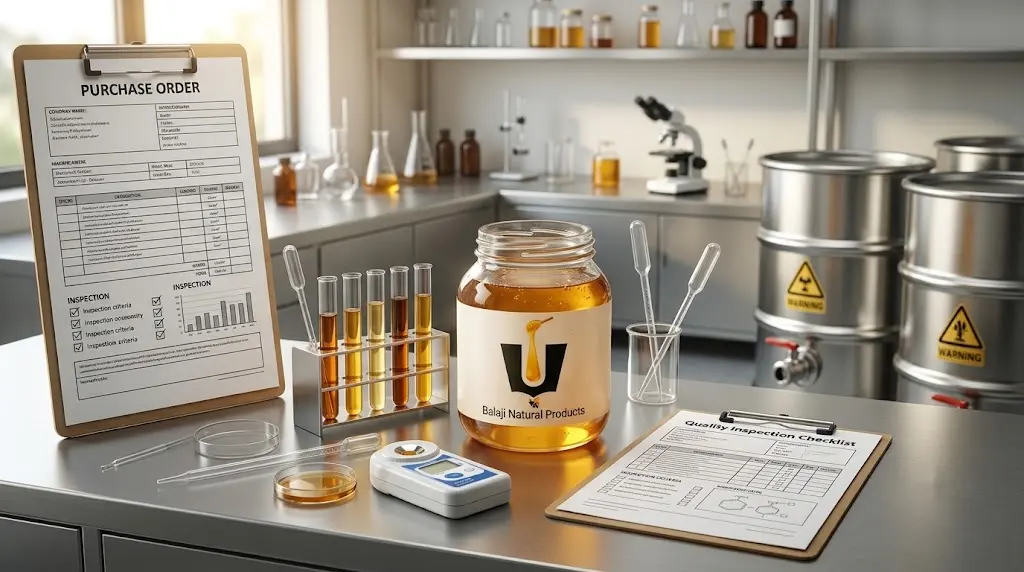
For businesses working with a Honey Supplier India, a purchase order (PO) is an important document for defining the quality parameters that the supplied honey must meet.
Without written specifications, buyers and suppliers may have different expectations about moisture content, sugar composition, HMF levels, purity testing and other quality requirements.
For example, a food manufacturer may require honey with a particular moisture range, while an exporter may need additional adulteration screening and destination-specific documentation.
These requirements should be discussed and documented before production or dispatch.
A well-prepared purchase order helps both parties understand what will be tested, which limits apply, how results will be reported and what happens if a batch does not meet the agreed specifications.
What Should a Honey Quality Specification Include?
A honey quality specification is a written set of measurable requirements that describes the expected characteristics of a product.
It helps purchasing teams, quality control departments, laboratories and suppliers work towards the same standards.
A practical specification should cover the following areas.
1. Honey Type and Product Identification
Start by identifying exactly what you are purchasing.
Honey varieties can differ in colour, flavour, aroma, composition and natural characteristics.
Your purchase order should mention:
Honey variety or floral origin, where applicable.
Natural honey or the specific certified product category.
Country of origin.
Intended application.
Processing requirements.
Packaging format.
For example, a food processing company purchasing multiflora honey should identify that variety rather than simply mentioning bulk honey.
This prevents confusion when multiple honey varieties are handled by the same supplier.
2. Moisture Content
Moisture content is one of the most important parameters in commercial honey procurement.
It affects honey's consistency, storage stability and susceptibility to fermentation.
Higher moisture levels can increase the possibility of fermentation under unsuitable storage conditions.
Buyers should specify the maximum acceptable moisture percentage in the purchase order.
For example:
Parameter: Moisture content
Unit: Percentage by mass
Requirement: As per applicable regulatory standard or mutually agreed product specification
Testing method: Approved laboratory method
For honey covered by India's current FSSAI standards, the general maximum moisture requirement is 20% by mass.
However, buyers should verify whether any applicable product-specific exception exists before finalising the purchase order.
3. Sugar Composition
Natural honey contains different sugars, primarily fructose and glucose.
Sugar composition is important when evaluating honey quality and checking whether the product meets applicable standards.
The purchase order can specify requirements for:
Total reducing sugars.
Sucrose content.
Fructose-to-glucose ratio.
Other relevant sugar-profile parameters.
Under the general FSSAI honey requirements, total reducing sugars must be at least 65%, while sucrose must generally not exceed 5%, subject to specified exceptions.
Buyers should avoid using vague descriptions such as natural sugar composition.
Instead, mention the exact parameter, unit, minimum or maximum limit and testing method.
4. HMF (Hydroxymethylfurfural)
HMF is a compound that can form in honey during heating and storage.
Its concentration can provide useful information about the product's processing and storage history.
For this reason, many commercial buyers include HMF testing in their quality requirements.
A purchase order should specify:
Maximum permitted HMF level.
Measurement unit (mg/kg).
Applicable regulatory or customer-specific limit.
Testing method.
Reporting requirements.
The general FSSAI maximum for HMF is 80 mg/kg.
However, buyers may establish tighter contractual requirements depending on their intended market and product application.
5. Diastase Activity
Diastase is a naturally occurring enzyme found in honey.
Its activity is another parameter used in honey quality assessment.
Excessive heating and prolonged storage can affect enzyme activity.
Buyers should specify the required minimum diastase activity and the analytical method.
The current Indian standard provides a general minimum of 3 Schade units per gram.
Any additional customer requirements should be clearly mentioned in the purchase order.
6. Acidity and Other Physicochemical Parameters
Other physicochemical parameters may also be relevant depending on the product and its intended application.
These include:
Free acidity.
Total ash.
Water-insoluble matter.
Electrical conductivity.
Proline content.
Specific gravity.
Not every buyer requires every parameter for every shipment.
A manufacturer purchasing honey as an ingredient may have different testing priorities from a retailer or an international importer.
The objective is to identify the parameters that genuinely matter for the intended application and document them clearly.
How to Define Testing Requirements in a Purchase Order
Once the required quality parameters have been identified, the next step is to convert them into measurable contractual requirements.
A purchase order should not simply state that honey must meet premium quality standards.
It should explain exactly what premium quality means for that particular transaction.
Specify the Acceptable Limits
Every required parameter should have a defined acceptance criterion.
For example, instead of writing:
"Moisture should be within acceptable limits."
Write:
"Moisture content must not exceed the maximum limit agreed in the product specification and applicable regulatory requirements."
Where appropriate, include both minimum and maximum values.
This makes the specification measurable and reduces interpretation differences.
Mention the Testing Method
Different laboratories may use different analytical procedures.
Therefore, buyers should identify the required testing method or refer to an agreed testing standard.
For example, moisture may be determined using a refractometer or an approved laboratory procedure.
Sugar composition may require a suitable analytical method, such as titrimetric analysis or HPLC, depending on the parameter.
The FSSAI's 2024 Manual of Methods of Analysis of Honey and Other Bee Hive Products provides specific methods for testing several honey parameters.
[External Link: FSSAI Manual of Methods of Analysis of Honey and Other Bee Hive Products]
Define the Sampling Procedure
Testing is only useful when the sample accurately represents the supplied batch.
The purchase order should establish how samples will be collected, identified and submitted for analysis.
Consider specifying:
Batch or lot identification.
Sampling location.
Sampling frequency.
Sample quantity.
Sample sealing and labelling.
Responsibility for sample collection.
Retention of reference samples.
For large bulk orders, buyers may also require samples from different containers or defined portions of a shipment.
This helps reduce the risk of relying on a sample that does not represent the complete consignment.
Identify the Laboratory Requirements
Buyers should clarify where the testing will take place.
Depending on the agreement, testing may be conducted by the supplier's in-house laboratory, an independent third-party laboratory or another mutually approved facility.
The purchase order should mention:
Laboratory name or approval criteria.
Required testing parameters.
Testing frequency.
Report format.
Accreditation requirements, where applicable.
If a buyer requires independent verification, this should be agreed before the order is processed.
Specify the Certificate of Analysis
A Certificate of Analysis (COA) provides documented laboratory results for an identified batch or lot.
It helps buyers compare actual test results against the agreed specification.
A purchase order should state whether the COA is mandatory and which details it must contain.
A useful COA should identify:
Product name and honey variety.
Batch or lot number.
Sample identification.
Date of sampling.
Date of testing.
Parameters tested.
Actual test results.
Units of measurement.
Applicable acceptance limits.
Laboratory identification.
A COA should relate to the actual supplied lot rather than being treated as a general certificate for all products from a manufacturer.
Additional Testing Requirements for Bulk Honey Buyers
Routine physicochemical testing may not be sufficient for every commercial application.
Some buyers require additional testing to evaluate authenticity, contamination risks and compliance with destination-market requirements.
Adulteration Detection
Honey adulteration is an important concern in commercial sourcing.
Different analytical techniques can help identify the addition of external sugar syrups.
Depending on the buyer's requirements, testing may include C4 sugar analysis, isotope-ratio testing, specific syrup markers and NMR screening.
NMR (Nuclear Magnetic Resonance) screening can provide additional information about the honey's composition and potential adulteration.
However, it should be specified separately when required.
Buyers should not assume that every supplier automatically performs NMR testing on every batch.
Residue and Contaminant Testing
Food manufacturers and international importers may require additional testing for residues and contaminants.
These requirements depend on the destination market, product category and intended use.
Possible testing areas include:
Antibiotic residues.
Pesticide residues.
Heavy metals.
Microbiological parameters, where relevant.
Other market-specific contaminants.
The purchase order should identify the required substances, applicable limits and testing methods.
A general statement such as "free from contaminants" may not be sufficient for technical procurement.
Colour, Aroma and Sensory Characteristics
Laboratory measurements do not describe every characteristic of honey.
Buyers may also have expectations regarding colour, aroma, flavour and physical appearance.
These requirements are particularly important for retail brands, food manufacturers and private-label businesses.
An approved reference sample can help establish expectations.
The purchase order should explain whether the delivered product must match the approved sample within an agreed tolerance.
Purchase Order Quality Checklist for Honey Procurement
Before confirming an order, purchasing teams should review the following information.
Purchase Order Requirements for Honey Procurement
1.Product Identification: Honey variety and product category.
2.Quantity: Required quantity and unit.
3.Moisture: Maximum acceptable percentage.
4.Sugar Profile: Required sugar parameters and limits.
5.HMF: Maximum permitted mg/kg.
6.Diastase: Minimum activity requirement.
7.Acidity: Agreed maximum limit.
8.Adulteration Screening: Required analytical tests.
9.Residue Testing: Destination-specific requirements.
10.Sampling: Agreed collection procedure.
11.Laboratory: Approved testing facility.
12.Certificate of Analysis (COA): Mandatory batch-specific report.
13.Packaging: Drums, cans, buckets or other agreed formats.
14.Traceability: Batch identification and supporting records.
15.Rejection Terms: Procedure for non-conforming material.
This checklist can be adapted to suit different purchasing requirements.
For example, an international importer may require additional traceability and destination-market compliance documents, while a domestic food manufacturer may prioritise ingredient specifications and batch consistency.
What Happens When a Honey Batch Fails Testing?
A purchase order should also explain how quality disagreements will be handled.
Without a predefined procedure, even a small difference in laboratory results can delay procurement or shipment.
Buyers and suppliers should agree on a clear process for non-conforming batches.
Establish Rejection Criteria
Define which test results will make a batch unacceptable.
The agreement should distinguish between critical failures and parameters that may be reviewed through further testing.
Define Retesting Procedures
If the buyer and supplier receive different laboratory results, they should have an agreed method for resolving the disagreement.
This may involve testing a retained sample or submitting a mutually agreed sample to an independent laboratory.
Document Corrective Actions
If a batch fails the agreed specifications, the supplier and buyer should document the next steps.
Depending on the contract, these may include rejection, replacement, further investigation or another mutually accepted resolution.
All decisions should be recorded against the relevant batch number.
Why Choosing the Right Honey Supplier Matters
Clear purchase order specifications are important, but the supplier's ability to follow them is equally important.
A reliable supplier should understand the buyer's quality requirements and communicate what testing and documentation can be provided for each shipment.
When evaluating a supplier, businesses should consider:
Experience in commercial honey processing and supply.
Availability of batch-specific testing reports.
Ability to meet agreed product specifications.
Traceability and supporting documentation.
Packaging and bulk supply capabilities.
Understanding of domestic and international requirements.
Clear communication about optional testing.
For businesses evaluating a Honey Supplier India, it is important to distinguish between facility certifications and actual batch-level test results.
A facility certification describes aspects of the manufacturer's management system.
A COA provides test results for an identified lot.
Traceability documentation addresses the product's supply-chain history.
These documents serve different purposes and should not be treated as interchangeable.
Balaji Natural Products provides information about its quality testing, certification and traceability processes, including optional testing arrangements such as NMR when specified by the buyer.
[Internal Link: Honey Quality Testing and Certification at Balaji Natural Products]
Buyers can review the relevant product and documentation requirements before requesting a quotation.
Conclusion
Setting clear honey quality specifications in a purchase order is an important step towards reliable bulk procurement.
It establishes measurable expectations for moisture, sugars, HMF, diastase activity, acidity and other relevant parameters.
It also clarifies testing methods, sampling procedures, laboratory requirements, COA documentation and rejection conditions.
For manufacturers, importers, food brands and distributors, these details can help reduce procurement misunderstandings and improve quality consistency across shipments.
When working with a Honey Supplier India, buyers should discuss their technical requirements before confirming the purchase order rather than relying on general quality descriptions.
Balaji Natural Products works with commercial buyers to discuss honey varieties, bulk supply requirements and the testing documentation specified for individual orders.
Planning a bulk honey purchase? Share your required honey variety, quantity, destination market and testing specifications with Balaji Natural Products to discuss your procurement requirements.